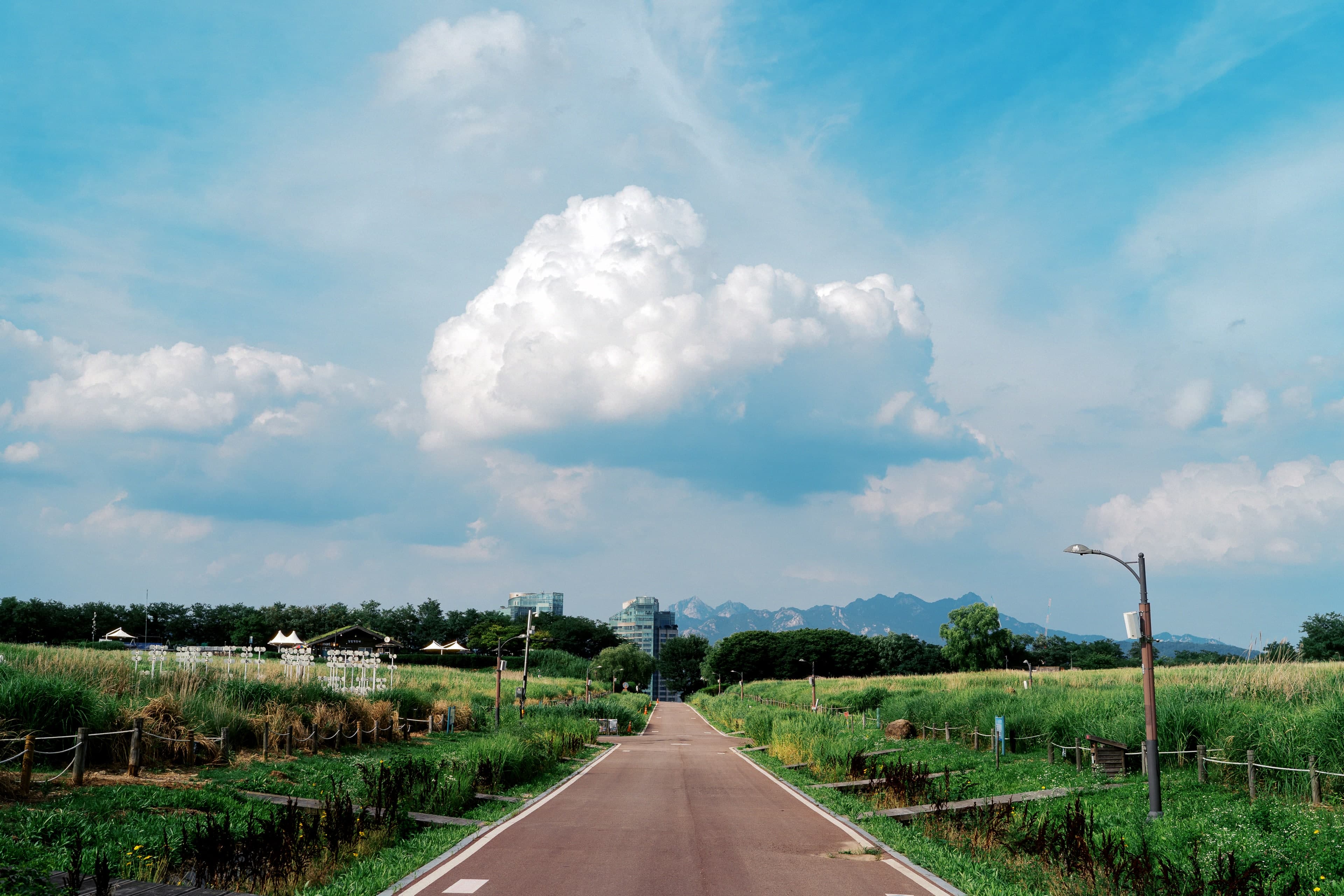
Haneul Park in Sangam, the Silver Grass Still Green
It has been raining for days. It stopped this morning, though the sky never opened, and the clouds only piled higher. The forecast says more rain in the afternoon. I half believe it and fold the umbrella into my bag.
Green is at its deepest around now, after days of drinking rain. On days like this what you end up wanting to walk is green. As deep as it comes, and long enough that walking does not use it up.
So I head for Haneul Park in Sangam. It is a low hill with the Han River along one side, known for the ridge lying down in silver every autumn. That silver is still two months off. It is Sunday and not many people are walking my way. This is not the season anyone comes for the grass.
Hot air comes down over my face before I have finished the stairs out of the station. A body cooled underground warms again in a few steps, and the back of my shirt takes a little longer. Nothing shades the sidewalk. Heat climbs off the asphalt as high as my calves.
A crape myrtle stands in bloom at the mouth of the road up the hill. One red thing alone against a sky rinsed by sun. Its other name means it flowers a hundred days, they say. Whether anyone has counted to a hundred I could not tell you, but it does hold all summer. In a season when everything else lets its leaves hang, this is the tree pushing flowers up, and under dry light it looks more in season than anything near it. The cicadas lay one layer over everything.
A few steps further a cat lies sprawled at the roadside. Head propped on the curb, rolled onto its side with its white belly out in the open. Footsteps go by and it does not open an eye. As I come near, the lids part by a thread. That is apparently confirmation enough, because they close again, and then the whole body turns over the other way. The belly shows wider than before.
Sleeping with your belly up is not something that works just anywhere. It means, at the least, that nothing bad has come along this road so far. What kind of place a park is, you learn from something like this before you get to the sign at the gate.
I like that untroubled face enough to crouch there a long while. My knees go numb, and the eyes never open again.
The Straight Metasequoia Road
There are several ways to the top. You can ride the cart that carries people up, you can wind around on the paved road, or you can take the stairs straight up. Any of them arrives in the same place. The summer sun is at its strongest just now, so I put the climb off and spend the time in the metasequoia grove instead, waiting for the light to ease.
Down where the land lies low along the river, several straight roads run between double rows of metasequoia. Out in the open sun my shirt sticks to my back and my eyes keep narrowing, and two steps in among the trees all of it lets go at once. The heat leaves my forehead first, then my forearms cool, and only after that does my breathing settle. Rain from the morning is still down here and the air is damp.
Overhead the leaves filter out nearly all the light. What gets through falls to the ground in small pieces, and the pattern crosses the tops of my shoes as I walk. Big trees keep a separate season of their own underneath.
My pace slows on its own. Nothing is waiting for me, and hurrying would only finish this coolness sooner.
The shade runs long and then opens all at once at the far end. The light pools there and comes no closer. An eye walking through the dark is pulled toward the bright side, and the distance does not shrink however many steps I take. Like light leaking under a door. The soil is soft enough to take the sound out of my steps, which leaves the cicadas louder.
I tilt my head back. The trunks narrow as they rise and go into the green, and only broken light comes down through the small leaves. Staying like that stiffens the back of my neck, and lowering my head takes a moment. Standing under things several times your own height makes you briefly smaller.
Metasequoia leaves are strange. Follow one with your eye and the fine branches divide into finer ones until you cannot say where a single leaf ends. A low branch happens to hang at eye level. I touch it and the small leaves give softly, then spring back. Water is still on them and my fingertips go cool for a second.
This tree was once known only as a fossil, they say. It sat in the books as an extinct species until a living one turned up in a mountain valley somewhere and the name came back. With the sun behind me, white sky shows through the divisions of the leaves. All that distance in time, thin and lit, right in front of my eyes.
There is not much sound on this road. Cicadas, a bicycle wheel now and then, and that is all. The bicycle arrives as sound from behind, and once it passes the sound moves ahead of me and stays there a long time.
Green and shade come half and half, and no sun reaches my back at midday in high summer. Time goes slower than it did a while ago. Wet earth, the raw smell of grass, river wind arriving from somewhere.
Birds come into this shade too, it seems. Azure-winged magpies chatter among themselves between the trunks, moving from this branch to that one. They are known for traveling in loud crowds. The sound shifts from my left to my right and comes back again.
One of them lands on a thin branch in front of me. The branch dips once under the weight. It does look at me, though not long enough to suggest I was worth much.
An orange frame stands at the end of the road. Beyond it the same trees continue in rows into the distance. This path was joined to the next park not long ago, they say. It used to stop here, and now you pass the frame and keep walking.
I stand at the frame a while and look through. It will be this cool in there too. I leave that for another time.
The Stairs Up to the Sky
The shade thins with every step. The sun settles onto the back of my neck again, and at some point the sky widens all at once. In one corner of that open sky a steel transmission tower juts up. A tower in the middle of a park seems out of place.
Retrace the order, though, and the tower is not the odd one here. This hill was never a mountain to begin with. What the city threw out day after day piled up in this spot until it stood as high as one, and for a time people lived up on it, they say. Soil went over the top, seed went into the soil, and the park opened in 2002. Under my feet now the Seoul of those years lies pressed whole, and the grass and the trees came up over it much later.
The steel stairs climb the green slope in zigzags. I count the turns and give up around four. The railing is warm from the sun, so my hand comes off it as soon as it goes on. When someone comes down toward me we each step aside a tread, and we nod. The same angle and the same sound at every turn.
Around the tenth step my calves stiffen. A line of sweat runs down my spine and my breath breaks every second step. The steel plate rings low and dull wherever I land.
At a landing I turn and look back once. The metasequoia road I walked out of is already lying below. Sound comes off in layers as I climb. The cicadas go, the traffic goes, and in the end there is only my own breathing and the ringing of the plate. These are stairs you climb knowing what is down there underneath them. Knowing does not change how they feel underfoot.
At the top of the stairs the wind coming over the ridge takes the sweat off my back in a single pass. The wet shirt lifts away from my skin, my back cools all at once, and my breath comes back to me. While the heat leaves, the wind turbine that was far off a moment ago is suddenly at eye level. The white blades turn slowly and make the electricity the park uses, they say.
The Summit, a Field Before the Silver
The top is flat. More a field than a hill, and the field is all silver grass. Green to my waist in every direction, with no end in sight.
Each time the wind passes, the whole ridge tips one way and comes back. The sound is like someone turning the pages of a thick book far away. Wind cannot be seen, but on this hill the grass reports every place it goes. You can count off the time it takes to cross from that far edge to this one.
Turbines stand at the far end and beyond them the city settles low. Two people crossing the field walk half sunk in green. Even walking slows down up here.
I bend at the waist and bring my eyes level with the grass. The world narrows to a few layers of green with sky wedged in pieces between them. Wet leaves warmed by sun give off a lukewarm smell. Not a smell I have taken in often, and familiar somehow all the same.
Above it the cloud has swelled, dark along its underside. I open my bag, check that the umbrella is there, and close it again. I still half believe the morning forecast.
Far beyond the field a single white chimney stands straight up. The grass sweeps green to the end of the ridge and that one cylinder does not move in the wind. When one thing holds still among things that are moving, the eye keeps going back to it. And then comes back to the grass.
Between the stretches of open sun, a few big trees gather here and there and lay down shade. Under them the heat leaves my forehead first. The summit wind catches in the branches and softens a layer, and the cicadas grow closer together instead.
People who got here before me are sitting in the pavilion. One has shoes off and legs stretched out, one fans himself and looks straight ahead. People who came in out of the sun, saying nothing. I sit down on the edge of the floor and feel my calves let go.
After dark the hill takes no one in and stands empty all night, they say. Left dark, like a room you turned the light off in on your way out. The wind must blow while nobody is here. What the field sounds like then, I have never heard.
Coming out of the shade the sun arrives all at once. While my eyes adjust the grass reads white for a moment, then comes back to green slowly.
Here and there among the green filling the ridge, some stalks have already pushed their heads up. The ones that came early have lost their water and gone dry gray. They grew in the same field, and there seems to be no rule about which ones turn first.
A small white dog comes trotting up the path. Tongue out and panting in the heat, and every step of it full of excitement anyway. The grass is taller than the dog, so the little body sinks into the green and rises again a few steps on, the white head lifting and dropping over the top of it. I watch it come, joining the risen places to the sunk ones with my eyes.
All four feet stay busy right up until it passes me. It looks up at me once and does not slow down at all. The face of someone with a great many places to be.
I look closely at one stalk at the edge of the path. My hand touches it and the head catches for a moment, then slides off my fingers. Something rough stays on my fingertips.
It is only just opening, and a few strands have gone gray already. What do you call this. Too pale for green, too early for silver.
Deeper into autumn the whole hill turns silver, and the paths through the field fill with people who came for the sight of it, they say. That crowd is a long way off. What is here now is a thing before it is finished, and because it is not finished nobody comes to look. Which, of course, is why I came up in this season. Once the grass has turned all the way, this green is nowhere to be found.
The blades are turning right above my head. The same wind that laid the grass down is pushing them here. One turn takes longer than I expect. Follow a blade past the top and down and the next is already on its way up.
Standing this close, I can hear it. Not loud, a low pushing sound that breaks and resumes on a beat. Out in the middle of the field there is no hearing it.
A large stone stands with Haneul Park carved down its face. Everyone passing in front of it stops. They stand with their backs to the stone, take one picture, and go on the way they were going. It is hard to walk past a stone with a name cut into it.
The name Haneul Park was given after the hill was finished. What this place was called before is Nanjido. It means an island where orchids and sweet herbs grew, and people called it Flower Island as well, they say. A name went that long meaning nothing, and only now is it beginning to add up again.
Seoul Seen from the Sky
I walk out to the edge where the field ends. In a few steps the ground drops away underfoot. A place with nothing in the way. The wind comes straight at my face.
Below, the Han River lies wide. Seongsan Bridge in red and World Cup Bridge beside it hang across the water, and the river passes both and goes off between the buildings. From this height the water does not look like it is moving. Watch long enough and only the cars on the bridges do.
Turning my eyes to the left, the white roof of the World Cup Stadium swells up large. Behind it the tall buildings of Sangam run on at more or less one height, and further off the tower on Namsan stands thin.
That roof and this hill came about around the same time. One was built to be shown, one was covered to be hidden. Now people come to see both.
Directly below, an apartment complex that shares its name with the park sits up against it. The white blocks stand in straight rows and then stop, and at the end of them the rock ridge of Bukhansan rises rough. Lines a person drew and lines nobody drew, laid over one another.
On one side there are more trees than buildings. A hill wearing a forest curves gently and holds a low building half seated in it. The rain has only just stopped and the air is washed, so even far things stand out as sharply as near ones. Distance is hard to judge.
Lookouts sit here and there along the loop, so I keep stopping on the way. Before going down I put my eyes on the river one more time. Across the water the tall buildings of Yeouido stand in a group, and among them one old gold building still shows. At my feet a wide green flat lies along the river.
However long you look, only some of it comes with you. I take a few photographs, and after taking them the thing I have just seen seems to shrink a little. So I walk a few steps and turn back for another look. Not that looking twice lets you carry any more of it.
The Maengkkongi Up and Down the Hill
A little way down from the top the field draws back and a wide paved road opens under the trees. A different sort of road from the path through the grass, broad enough for a car. What meets my soles turns from earth to asphalt and the sound of my steps comes back.
A white cart comes up the road slowly from below. The motor arrives from beyond the bend first and the cart appears well after. A few people sit in the open body under its bare roof, and it moves close enough to walking pace that the riders and the walkers go up the slope side by side.
It carries people who would rather not take the stairs, up the hill and down, and one ticket gets you to the top without a drop of sweat. It costs almost nothing. I decide to walk down anyway. Riding it would end the day too quickly. Not that walking makes a day any longer.
The cart is called the maengkkongi cart. The maengkkongi is a small amphibian that used to live in the wetlands here, and it lost its water when the city came in and went missing for a while. Then the hill turned into a park, puddles came back on top of the soil, and it found its old place again and started laying eggs, they say.
It is not often that something which left comes back on its own. Whether what came back is the same as what left, of course, there is no telling. They call at night, they say, so nobody who comes up in the daytime will hear one. The name is fixed to everything up here, and I go back down without once hearing the sound it came from.
Down Through the Woods
The cart that set its passengers down at the top goes back empty the way it came. A slow name on a slow thing, which suits it. I watch it shrink toward the bottom, then take the woods path on the other side.
Branches meet over the brick paving and make a tunnel, and the sun that was warming my back cuts off at its mouth. Going down puts the weight on my knees instead of my calves. The field I walked out of a moment ago is already far away. The sound that came off in layers on the way up comes back in layers on the way down.
A small sign hangs on the railing. A drawing telling you to watch for snakes. On a walking path this well kept it seems unlikely, and still nobody hangs a sign for a thing that never happens. After that my eyes keep going to the grass at the edge of the path.
The maengkkongi came back because people called it, and nobody called the snakes. The same goes for the magpies. People designed this hill and built it, and things that were not on the list walked in and live here. Outside the path people made, the ground is not theirs yet.
Out of the woods the wide paved road opens again. It is the road the maengkkongi rolls up and down. Pagoda tree flowers have fallen thick and mottle the ground yellow, and a barrier gate shows down below. The descent will end somewhere around there.
Sun slants into the woods beside the road and scatters light and shade in small pieces around the base of each tree. Thick trunks cover the low slope, and inside it is quiet at midday. When I stop walking the quiet settles a layer deeper.
Whatever is buried under the soil, the trees that grew above it are as thick as the trees of any other wood. The roots probably know. They grew knowing, and they have been growing for more than twenty years now.
Closer to level ground the path fills with people. Runners with even breathing pass close by, and a family with a dog out front walks slowly the other way. Each one going past raises a small wind.
If the field up there is a place you make up your mind to climb once, down here is somebody's neighborhood back road, walked without a thought every day. The same hill, and the top and the bottom used as if they were different places.
The road curves gently along a stone wall. The bend is hidden behind the wall, so footsteps from the other side arrive before the people do. The shade along the wall touches my skin. The branches meeting overhead are cherry. What this road looks like in spring I leave to guessing.
Down off the hill I look up at the sky one last time. This morning's cloud is still swollen where it was. It never broke all afternoon, and the umbrella stayed folded in my bag the whole day. There are days you carry a thing along and never once use it.
The stairs I went up and the road I came down are not the same road. All I did was go once around one hill, and because the way up and the way down do not join, it feels like coming out somewhere other than where I went in. A folded umbrella, shoes not yet dry, salt drying on my back. Summer is a season like that, laying a layer over everything and lifting it off when the time comes. When this green has gone all the way to silver and I come back, what will the hill have covered by then.
Reference
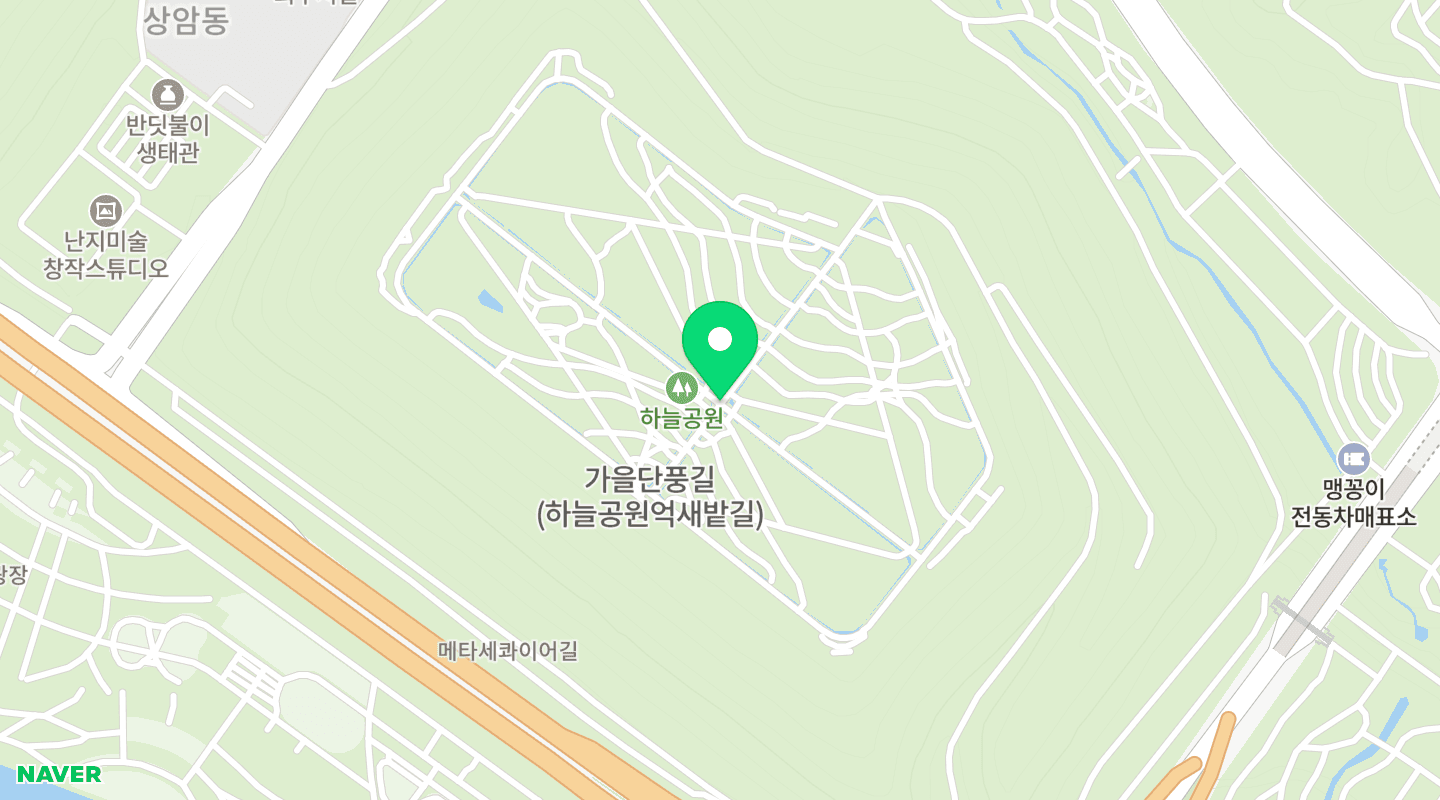 Open in Naver Map
- Hours: 05:00 ~ 20:30 (shifts with sunset)
- Getting there: World Cup Stadium Station (Line 6), Exit 1, a 15-minute walk