National Museum of Korea, the Slowest Day in the Monsoon
It has been raining for days. There is only so much a single umbrella can do, and this is not the kind of rain that clears in a day or two. On days like this, what you end up looking for is a roof. Something large, and forgiving of a long stay.
At the ticket gates of Ichon Station I fold the umbrella and shake it out a few times. However carefully you shake an umbrella, some water always stays behind. There are a few things in the world like that. I settle for good enough and start walking, because in this season the most generous roof in Seoul waits at the end of that station's underpass.
I am hardly the only one with the idea. Past the gates, the crowd bound for Exit 2 gathers into a single current, and unfamiliar accents surface here and there. This shelter does not belong to Seoulites alone. Signs cover every wall, so there is no need to ask the way. On a bench along the passage someone waits for a companion with eyes on a phone, and on the glass wall beside them runs a single line: the National Museum of Korea is open every day of the year. In a city deep in the monsoon, you rarely meet a promise more dependable.
An underpass called the Museum Nadeulgil runs from the station to the mouth of the museum. Ceiling panels lay down an even, square light in place of sky, and the moving walkway drifts a half-beat slower than a walking step. I give myself to that pace. Nothing about the day asks me to hurry, and when I think about it, not hurrying is the whole reason I came.
Someone drags a suitcase toward me, two people lean side by side against the handrail, and overhead an arrow points the way to the museum. Water left on umbrellas, a low hum, footsteps folding into one another. Somewhere in that long passage comes the feeling of crossing from one side of the world to the other. The museum has begun well before the galleries, down here underground.
The Reflecting Pond and the Open Court
The passage ends, and up a flight of stairs the smell of rain returns. Warm, damp July air. I have only just forgotten it, and yet it feels like a smell met again after a long time apart.
The Reflecting Pond is full of the sound of rain. Wherever a drop lands, rings gather on the surface in layers and dissolve. I have been thinking that if you sat between the pillars of the celadon-roofed pavilion at the pond's edge, you could wait out the rain and watch the water. Someone steps in ahead of me and does exactly that. The celadon of the rain-soaked tiles is deeper than on a dry day, and inside the pavilion time moves at the speed of a spreading ring. I stand a moment to the same beat, then walk on.
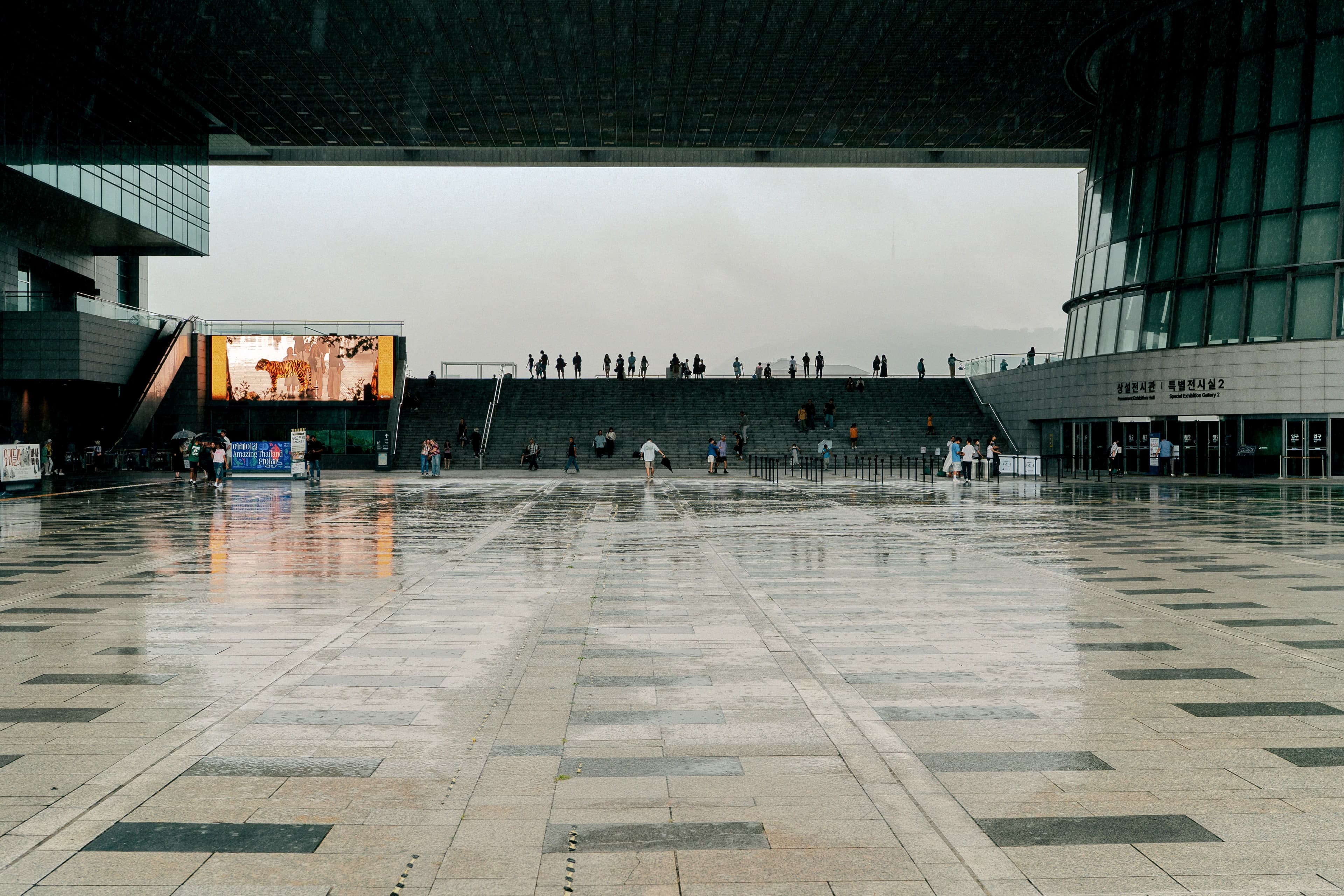
At the landing the building finally shows its full size. A long block of granite lies with its whole middle hollowed out, and through that empty space passes the gray sky. The design enlarges the wooden hall of a hanok to the scale of a building, so there is a roof but no walls. Crossing the court, the wind carries the smell of rain to me again and again, freshly each time.
On a clear day, they say, N Seoul Tower hangs squarely in this rectangular frame. Today the mist has rubbed out half the view, and only the tower's outline is left. People stand at the railing above the stairs all the same, umbrellas lowered, and watch the blurred scene a long while. I join them and look the same way for a time. There is a reason, probably, for choosing to look hard at something you can barely see. Across the wide stone floor lies only the low sound of rain.
A Door Without a Threshold, and the Path of History
I push the glass door of the permanent galleries, and cool, dry air comes at me. Air of a different kind from the world of a moment ago. Inside the door there is only a bag check. No ticket booth, no gates, no one checking tickets. People shake out their umbrellas once at the check and drift straight in. I shake mine one more time and fold into the current.
The permanent exhibition has been free for a long time. Free is a bigger word than it sounds. The arithmetic of getting your money's worth is erased at the door, and you can come to escape the rain when it rains, or to let time pass when time is spare. Lately there is talk, inside the museum and out, of putting up a price list, but for now it is still the season of free admission. That a city holds a place like this is a rather fine thing. Though fine is a little short of it.
Past the lobby, a passage opens in a straight line to the far end of the building. It is called the Path of History. Galleries stack up left and right, and overhead is a glass ceiling. Mirrors in the roof are said to turn with the sun and bend light indoors, and on an overcast day the light is soft in its overcast way. Voices and footsteps rise to the high ceiling and scatter. For the sound of this many people, it is a strangely low, round sound.
Midway down the path stands the banner of a special exhibition called Our Table. I mean to look in if time allows, but the permanent galleries alone are more than a single day can hold, so the special show will keep for another time. A guide robot slides among the crowd, and a small band trails close behind it. When the robot turns, everyone turns with it. Far beyond, at the distant end, stands an ivory pagoda. The distance at which an indoor tower shrinks to a single dot. Before I have taken a step, the scale of the building reaches me in the body.
One whole wall of the path is a map. The Daedongyeojido, the great map Kim Jeong-ho printed in 1861; unfold all twenty-two folios and join them, and you get a Korea three stories tall. Mountain ranges in thick lines, waterways in thin ones, a whole country packed into one wall. People wait their turn, stand with their backs to the map, and take photographs. Somewhere on that map sits the very Yongsan the floor stands on. People inside a country, photographing themselves against the country. A strange sight, somehow, though the strangeness is not unwelcome.
Faced with more than a day can cover, you have no choice but to fix an order. I had planned the route before coming. The second and third floors first, then down to the first. Save what you love for last and your legs give out right in front of it, a thing I learned on an earlier visit. Passing the first-floor galleries, I step onto the escalator beside the pagoda. The pagoda's waist slides slowly past my eye level, and the base I looked up at from the first floor becomes, before I know it, the body of the tower. Around this one pagoda the whole building winds in a spiral.
The King's Library, a Procession in Green Silk
Turning into the calligraphy and painting gallery on the second floor, the light drops sharply. I stand a moment at the threshold, waiting for my eyes to take to the dark. Then gold letters surface out of it. The King's Library: Dreaming of a Benevolent World. It is the gallery devoted to the Oegyujanggak Uigwe, opened late in the autumn two years ago, and modeled, they say, on a royal library into which moonlight seeps.
The Uigwe are, put simply, the records the Joseon court kept from start to finish, in text and picture, each time it carried out a great affair of state. King Jeongjo built the Oegyujanggak on Ganghwa Island, and there he kept, among them all, the royal-viewing copies the king read himself.
During the French campaign of 1866, French troops carried some 340 volumes off by ship, and the books that remained burned along with the pavilion. The volumes taken away slept a long while in a library in Paris, miscataloged as Chinese books. Park Byeong-seon, a historian based in France, found them, and 297 volumes of the Uigwe came home to Seoul in 2011, 145 years on. It was not, though, a whole return. On paper it is still a loan, renewed every five years. Their bodies have come back while their names are still guests. That there is so wide a gray zone between losing a thing entirely and recovering it entirely, I see for the first time in that room.
The room is a procession of those books. Between pillars and lattice doors built to the actual size of the Oegyujanggak's interior, Uigwe covers stand in ranks across the walls. Each cover under a low backlight looks like a lit window seen up from a dark alley. In each window sits one great affair of state. A king's wedding, a queen's funeral, a dowager's sixtieth birthday, the repair of a palace.
The deeper in you go, the narrower the passage grows. The design borrows the order of the banchado, the painting of a royal procession. Voices lower of their own accord, and people raise their phones to the wall with their footsteps hushed. A Snoopy charm swings from one bag. Books that crossed the sea and came back a hundred and sixty years ago, and a Snoopy, share the same dark. I like the pairing.
Up close, the Chinese title slip pasted vertically on each cover stands out white and clear. In the case, an original royal-viewing copy: green silk covers, cream paper, upright regular script over red rules, brass chrysanthemum studs. A book made for one man. They bring out only eight volumes at a time, I am told, and change them every three months. For books that waited 145 years, there is no telling what three months amounts to.
The Room of Quiet Contemplation, Two Smiles
Across the same floor, the corridor into the Room of Quiet Contemplation is long and dark. On the walls a film runs in black and white. Ice melting to water, water scattering to vapor, a film about the cycle of matter. The life of water, watched in the thick of the monsoon of all times. The drops that fell from the tip of my umbrella that morning rise naturally over the image.
The corridor filters the noise outside layer by layer. It is like going slowly down a deep well. By the time I near the end, both eyes and ears have taken to the dark. Then comes a smell. From the walls, said to be coated in red clay and charcoal mixed with cinnamon, a smell comes across like the drawers of an old herbal pharmacy.
And then the room opens.
From the ceiling hang some twenty thousand metal rods, each a little different in length. Rain stopped still in midair. The floor tilts up so gently no one notices, so everyone slows without knowing they climb. At the center, on a low oval dais, sit two figures. One leg crossed on a knee, a fingertip to the cheek, held in that pose for a very long time: the Pensive Bodhisattvas. The designer, they say, had in mind a small theater where the actor's face reads even from the back row, and true enough, from the threshold the smile on each of the two faces is clear.
The one on the right wears a low crown of three joined peaks. The eyes are lowered, and at the mouth hangs something too faint to call a smile, too warm to call blankness. It looks, I think, like the face of someone about to take a call from very far away. The bell has been ringing fourteen hundred years, and he is in no hurry at all. The finger to the cheek neither presses nor props, light as anything. What shape a hand takes at the moment thought runs deepest, the artisan of the seventh century must have known.
The one on the left wears an ornate crown set with a sun and a crescent moon. The form of the crown, they say, came from a Persian crown far away. An ornament that crossed the whole Silk Road and came to rest on this face. A long journey. Over the dark blue-green bronze skin, gold remains here and there, and under the lights the colors of two eras flicker together.
The room holds not a single label. No glass either. Fourteen hundred years sits within arm's reach, and no one reaches out. That hand's width of air is harder than glass.
People circle the oval dais slowly, taking in the backs and profiles you cannot usually see. I go around once too. Seen from behind, the two figures sit looking toward the same place. From behind alone, they look like two who have lived together a long time.
The line at the entrance doubles as the room's instructions. A time to weigh things broadly and sink into deep thought. Leaving umbrella and monsoon and wet shoes outside the door, people do nothing, briefly, in the dark. Beside two who have gone on doing nothing for more than a thousand years, doing nothing is the natural thing instead. That every step out of the room is slower than the step in is probably why. My own pace never does come back.
Between One Gallery and the Next
The museum has as many places to sit as to walk. Crossing several eras in a single step tires the head before the legs. On a bench beneath a marble wall, two people sit face to face, turning what they have just seen back over in talk.
Beneath a tall stone column, two more sit shoulder to shoulder, saying nothing, only scrolling their screens. A folded white umbrella leans between them, drying slowly.
On a red sofa in the lounge, someone has tipped their head all the way back and fallen asleep. Even on a rainy weekday there are people everywhere, but the building is so vast that the resting places, at least, are plentiful. This is a museum that drew 6.5 million last year. That sleep comes to you indoors, out of reach of the rain, suggests the body believes it is under a solid roof before the mind does.
Beneath the curved wall of the Grand Hall, a long stone bench bends along the wall's line. Three people sit against a wall of wide blank space, two shoulder to shoulder, one set a little apart. The space the three take up on that broad wall is very small, and small, it looks all the more composed.
The upstairs corridor is another path. A child crosses in front of a screen introducing the sculpture and crafts gallery. In one hand is a still-folded umbrella. Some things stay in hand even this far in under the roof, and the monsoon leaves its mark indoors that way. The murmur from below has not made it this high, and each footstep begins to be heard again.
Some doors are closed. Before the Buddhist sculpture gallery hangs a large notice: closed from three days before my visit until the end of the coming January. A renovation to run more than half a year. People look a moment at the wooden Buddha's face on the notice board, then move on to the next gallery. I think about the half year past that door. In the dark, with no one coming to look, what do the Buddhas do. Much the same as they have been doing, I conclude, probably.
Seen down from the railing, the Path of History looks longer than when walked. Voices that only scatter below rise here gathered into a single layer, and past a media column wrapped in water-colored footage, small figures cross back and forth.
About when my legs grow heavy, the smell of coffee spreads from the end of the corridor. A tea house called Sayugonggan appears. On its wooden wall hang the Pensive Bodhisattva, the pagoda, and an incense burner as patterns. A coffee while watching the rain would not be bad, I think, but the line at the order kiosk is longer than any line in the galleries. I give up on the coffee and keep walking. The smell alone, filling the corridor, gives some sense of having rested. Which is, of course, an entirely different thing from drinking a coffee.
The Room of the Moon Jar
I go up to the buncheong and white porcelain gallery on the third floor. Rooms where five hundred years of Joseon ceramics run in a single line. At their center sits one more room inside a room.
A dark cell, a single white porcelain jar, a blue full moon projected above it. That is all. And yet the room does not look the least bit empty.
The round body, nearly as wide as it is tall, is not a perfect circle. One side settled a little as it fired and leans, and fine crackle runs across the surface. There is probably no perfect jar anywhere in the world. And if there were, I would not much want to see it. Because of that lean, this jar stays longer in the eye than any perfectly round vessel. While the moon on the wall fills and fills again, the jar shines white in its place, and the people in the room keep a silence none of them has agreed to.
In another case on the same floor stands a bottle with a single cord draped at its neck. From the neck, painted dark in iron-brown underglaze, a brown cord runs down and ends near the belly in a single loop, curled round. A joke that takes the cord once tied at a bottle's neck and moves it straight into a drawing. This single line, drawn in a few strokes of the brush, is the hand of sixteenth-century Joseon, and the Korean letters carved on the foot declare it a thing made after Hunminjeongeum. Five hundred years ago, too, there were people who made jokes like this. The fact of it pleases me for no reason.
In one corner of the gallery sits a moon jar you see with your hands. A jar offered so you can lay a palm on the curve you had only looked at. I wait my turn and lay a palm on that curve. The feel of a cold, smooth surface turning slowly under the hand is the one thing that does not carry over through glass. The moon jar stands larger than expected, heavier than expected. After I lift my hand, the coolness stays on the palm a while. Then, without my noticing, it is gone.
A Ten-Story Pagoda Raised Indoors
At the end of the Path of History I finally stand before the Gyeongcheonsa pagoda I had put off. A marble pagoda raised in 1348, in the Goryeo dynasty, on a temple site in Gaeseong. Most stone pagodas on this land are granite, and this one alone is soft marble, so the grain of the carving stacked story on story resembles ivory work more than stone. On the base, the journey of the monk Xuanzang, and lions and dragons and lotus; on the upper stories, the Buddha's assemblies, packed close. I tip my head back among the crowd and my neck begins to ache. Thirteen and a half meters tall.
In 1907, a high Japanese official came as an envoy to congratulate an imperial wedding, and set his eye on this pagoda. When the villagers stood in the way, he had armed gendarmes take it apart by night and carry it off. Foreign correspondents exposed the plunder in the international press one after another, and the pagoda came back eleven years later. But the damage was severe, and for more than forty years it lay dismantled in a corridor of Gyeongbokgung. While it lay there, was it a pagoda, or only a long stone? Either way, forty years passed.
Nor was it simple after that. Only in 1960 did it stand again in the courtyard of Gyeongbokgung, and when acid rain dissolved the marble, it was taken apart once more in 1995. After ten years of conservation, in 2005, the pagoda came in under this roof. A place where it need never meet rain or snow again. On a day when the sound of the monsoon is distant only beyond the glass ceiling, this pagoda's life indoors is less a privilege than a convalescence.
From the third-floor railing you can look down on the pagoda. To look down from above is a line of sight a temple courtyard would never have allowed. Even the settled grain of years on each roof stone shows plainly. People on the floors below circle the pagoda slowly on its axis, and an escalator rises and falls at a slant beside it. In King Sejo's reign the Ten-story Pagoda of Wongaksa, in Tapgol Park, was raised on the model of this one, so the two marble pagodas in the heart of Seoul are brothers set roughly a hundred and twenty years apart.
National Treasures, Pocket-Sized
On the way out, the most crowded room is not a gallery but the shop. A museum goods brand called MU:DS keeps its lights bright beside the Grand Hall. The tidiness of the display is a match for most galleries, and at the door stands even a belt barrier to order the queue. People who have spent a day among things they cannot touch now line up before a room of things they can take home.
In the shop air there is not a trace of the monsoon's damp. Between the stationery corner and the hands-on corner, people press shoulder to shoulder, and the languages of other countries come from every side. The people who all whispered in the galleries let their voices loose here, and seem to spend before the goods all the words they saved before the treasures.
One counter glows yellow from far off. Cats in low three-peaked crowns with a fingertip to the cheek: Choonsik of Kakao Friends, turned into a Pensive Bodhisattva. The very pose everyone upstairs watched a floor above, breath held, is here stacked by the armful and sold.
Beside it sits a mint-green Ryan in a sun-and-moon crown. The two upstairs treasures have each gotten a doll of their own. Keeping a straight face before a lion contemplating in earnest takes a little effort. The smile of the second floor becomes, down here, a laugh.
The traditional counter is another matter again. The forms and colors that were kept behind glass upstairs come down here to within reach of a hand. Bell ornaments wound from colored paper cord swing with brass bells hung beneath them, and passersby ring one now and then as they go. A thing that would set off an alarm in the galleries ends here in a short chime.
One black bottle wears a military officer's hat. A broad-brimmed hat shrunk to the size of a bottle's head, a red tassel spilling from the crown, a string of colored beads hooked to the brim. It looks like the kind of stopper you cap a half-finished wine with. Rather too handsome, for something guarding a single bottle.
The keyboard on the shelf wears keycaps painted in dancheong, cap by cap. Most of the keys are sunk in colors like the ink-gray of roof tiles or the jade of celadon, and the bright color gathers around the Enter key. Lotus and bands of color rise in layers just as on the dancheong at the end of a ridgepole, so the key you press hundreds of times a day to decide something gets, on this keyboard, the most lavish treatment. For as long as I look, I am under the eaves of an old palace. When I come to, my hand has gone halfway toward the pocket with my wallet. A house that takes no admission collects, it seems, in the end right here, and drawing that hand back takes a little more effort than keeping a straight face.
The brand's showroom upstairs has set out an entire living room. On the sofa lean cushions modeled on the faces of the stone guardians that stand by royal tombs, and before them a white Pensive Bodhisattva doll holds a small one on its knee. Stone and gilt bronze, turned soft to the touch, set down in a living room.
In one corner of the lobby sit a pair of human-height Pensive Bodhisattva dolls. Velvet skin in place of the gleaming gilt bronze, the lowered eyes alone just as in the original. Everyone stops before them once for a photograph before moving on. Ever since a Pensive Bodhisattva miniature caused a sellout scramble a few years back, this museum's souvenirs have grown famous for being hard to get, and on weekend mornings, they say, the line forms first at the shop rather than the galleries.
Walk on and another shop, large or small, turns up at every junction. One by the entrance, one more between the galleries. The originals in their cases can go nowhere, but their miniatures leave through the door every day in someone's bag. That is how the national treasures scatter into the city, little by little, in a size that fits a pocket.
A Stone That Came Down from the Mountain
Heading for the exit, I stop one last time. Before a wall-sized black-and-white photograph of a rock peak stands a monument with worn corners. King Jinheung of Silla, having taken the Han River valley, raised it on the summit of Bibong Peak, on Bukhansan.
Through more than a thousand years of wind and rain on that peak, it was even mistaken for the monument of the monk Muhak. Only in 1816, when Kim Jeong-hui, the scholar known as Chusa, climbed Bibong and read out the moss-grown letters, did it get its name back. To keep it from wearing further, it came down the mountain in 1972, and a replica keeps its original place instead.
At the top of the peak in the photograph a full moon happens to hang. The stone cannot go back to the mountain, but the mountain has become a photograph and come round behind the stone. The sky this stone must have carried night after night for more than a thousand years is fixed, whole, on one wall.
Back Into the Wet City
Outside, the rain has stopped somewhere along the way. The hand that held the umbrella all day suddenly has nothing to do. A faint smell of washed earth and grass rises up. The ridgeline of Namsan, hazy all morning, now stands the tower back at its far end as a single thin line. At the top of the stairs two people watch that line, heads leaned together. They watch, a long time, the sight of a thing erased coming back to its place.
At the viewing railing just over, someone with a red backpack leans toward the city and takes a photograph. Cloud still covers the sky, but white light leaks at every seam, and below it the whole of Yongsan glitters wet and green. Soon that water will rise to the sky and come down as rain once more. The monsoon is a season, that way, of the same water moving up and down between the city and the sky.
As the rain thins, people who have pressed themselves under the eaves walk out one by one into the plaza. Over the stone floor, empty a moment before, folded umbrellas and footsteps scatter, and on the bench beneath the great tree at the center a family settles in. Knowing the clear sky will not last, everyone wears the look of wanting to be out under it while it does.
Down the stairs I step back into the Nadeulgil. The wet world and that short-lived sky both fall a step behind me, and only the bright passage, which knows nothing of weather, stays ahead. The things I brushed past today, how many more monsoons will they let pass in that place without a word? With a little of that indifference borrowed, I walk toward the city, its water not yet dry.
Reference
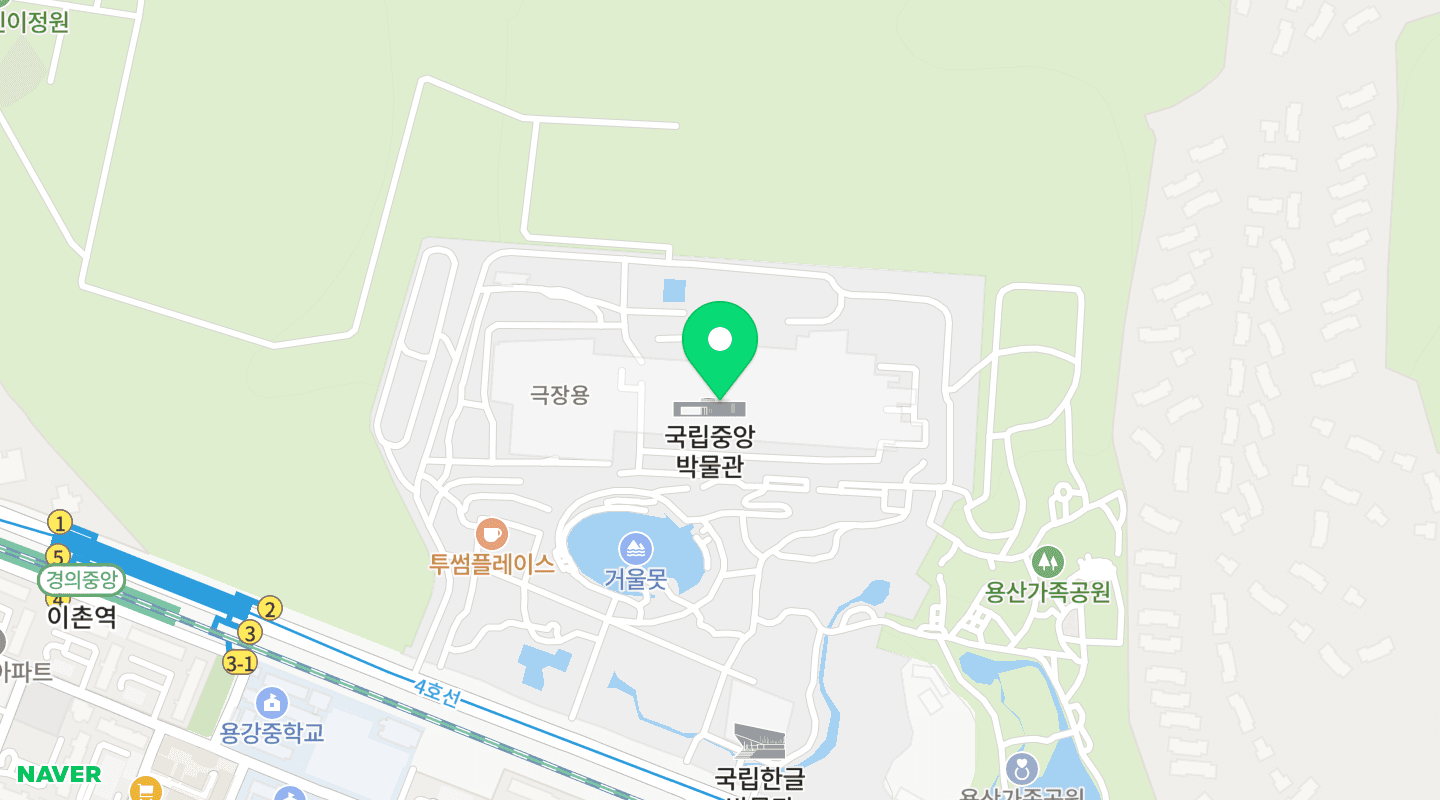 Open in Naver Map
- Dates: Open year-round (closed Jan 1, Lunar New Year, Chuseok, and the first Monday of March, June, September, December)
- Hours: 09:30 ~ 17:30 (Wed & Sat 09:30 ~ 21:00)
- Getting there: Ichon Station (Line 4, Gyeongui-Jungang Line), Exit 2, connected by the museum underpass
- Official site (opens in new tab)