Choansan Hydrangea Garden, a Terraced Hill of Shifting Color
When hydrangea season comes, people travel far for it. Some fly to the seaside trails of Jeju, some take the train down to the stone walls of a southern temple. That a low hill in Nowon, a few bus stops from Suyu Station, turns wholly to hydrangea each June is still little known.
A few years ago the Nowon district office planted hydrangeas across one face of the hill. As azaleas cover neighboring Buramsan each spring, hydrangeas now fill this slope each summer. A spot once sought out only by those who knew began, every June, to brim with color.
On a Saturday in June, I climb the hill to see it.
Elephants at the Gate
Out of exit 1 at Suyu Station, I change to bus 1133. It being the weekend, the bus carries its share of wide-brimmed hats and slung cameras. A few stops on, I get off in front of Yuwon Geukdong Apartment, and the garden entrance stands just across the road.
Large white letters set the garden's name on the slope, and that is all. No gate, no ticket booth. The light changes, the crowd surges across, and I fold into it and step inside the way you might wander up the hill behind your own neighborhood.
A family of green elephants meets the path at once. The mother, packed close with grass, curls her trunk upward; a little way off, a calf looks up at her. To the mother's left stands a white iron gate, and between the elephant and the gate, pink and blue hydrangeas have been set to spill like a waterfall. Between the elephant, taller than a person, and the pouring flowers, the entrance is crowded from the first step.
Step close to the gate and hydrangeas hang thick over its curved bars, an arch of flowers. Children throw their arms around the elephant's legs; grown-ups duck beneath the arch, the blooms grazing their hair, and take their turns at a photo.
A few steps past the gate, the whole slope above lifts into view, hydrangea from foot to crown.
The City Beyond the Beds
I climb the slope ahead slowly. A railed path winds around the low hill, and at every bend white and pink hydrangeas rise in tiers.
A little higher, the view opens between the trees. Apartment towers line the far edge of the flowers; underfoot is all bloom, and lift your eyes and beyond it is the city. Not some vast botanical garden, but a single neighborhood hill turned wholly to flower.
The climb is bright and hot. The midday June sun falls straight on your back. On the shadeless slope the heat pools, the sweat beading at your brow.
Just then the posts along the path breathe out a low hiss and a pale fog. Misting jets, set up to cut the heat. The fog settles low over the hydrangeas and strains the sunlight soft. Passing through it, the fine droplets touch your face, and the back of your neck turns cool for a moment. The climbers, flushed from the slope, slow their steps and stand a beat in the mist.
For a stretch after, the climb feels kinder.
The Colors the Soil Divides
Out of the fog, white blooms run in a line along the path. Annabelle, this hydrangea is called. Round as a closed pair of fists, dazzling white under the blue sky.
A hundred-year-old story trails this common-looking flower. In a country town in America, a woman riding past fell for hydrangeas blooming in a field and moved them into her own yard. The name Annabelle honors the young women of that town who first noticed the flower. A single clump gathered by chance from a field now stands in rows even on this Seoul slope.
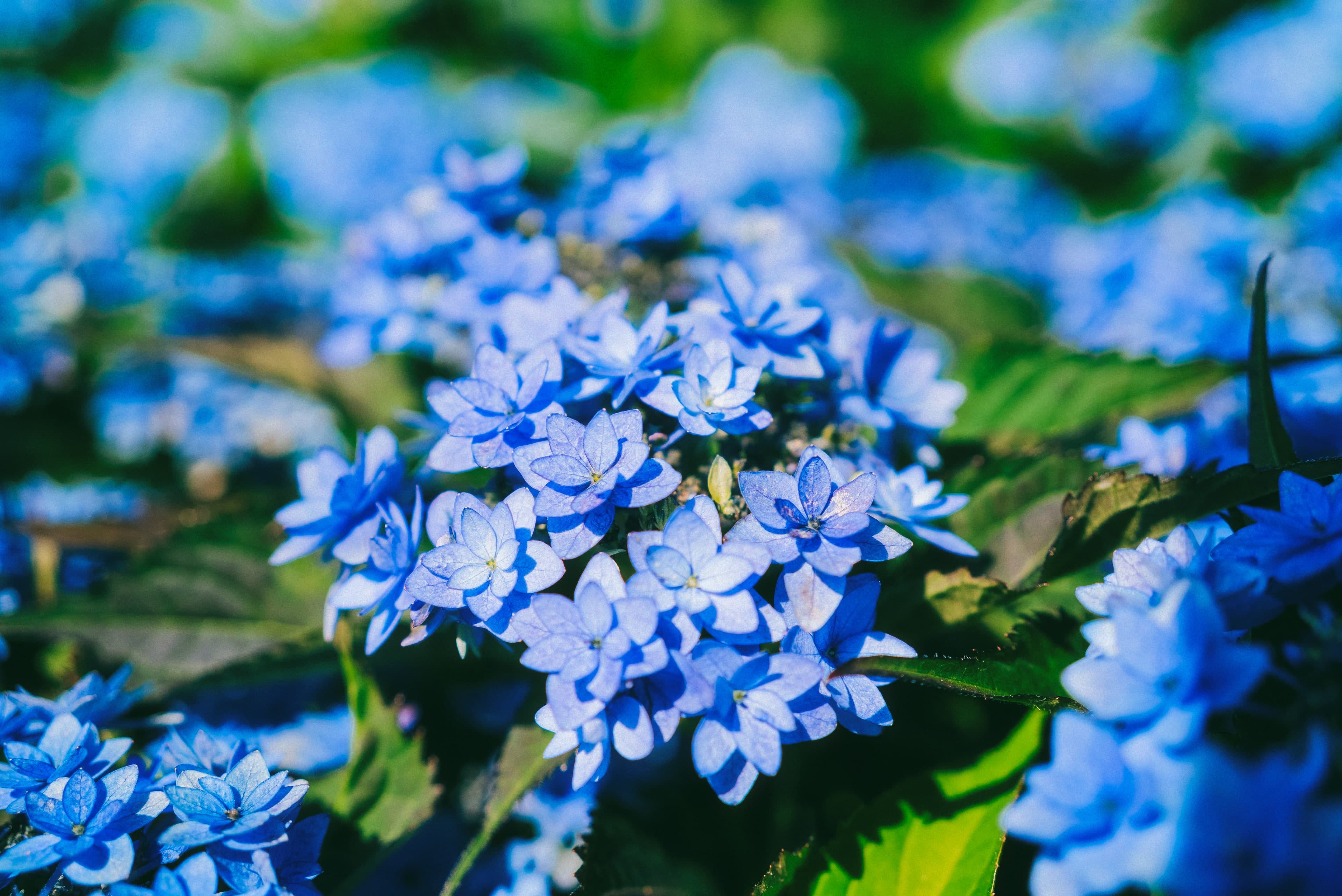
Where the white Annabelle ends, the colors divide. The same hydrangea blooms pink in one stretch and blue in the next. Not because the variety differs, but because the soil underfoot does. Where the ground is acidic, the roots draw up aluminum and the flowers turn blue; where it is not, they stay pink. The acidity shows plainly in the color of the bloom: sour underfoot, blue; otherwise, pink. This is why hydrangea is likened to a living strip of litmus.
Only the white Annabelle just passed is the exception. With no pigment for blue or pink to begin with, it stays white in any soil. Among flowers that take their color from the earth, it keeps its own white, holding what it held a century ago in that field.
What stops you, though, is the blue lacecap, blooming in layered stars. Instead of massing round like Annabelle, small flowers fold into star shapes, each cluster sharp in outline. Look close and the large showy flowers at the rim and the millet-fine ones at the center keep apart. The big outer ones are not petals at all but swollen sepals; the true flowers are the small ones within.
The showy false flowers draw bees and butterflies inward, and once the true flowers have set seed they quietly bow their heads and turn away. From that turning, the work done, hydrangea took its flower-meaning: a change of heart.
Trim as a single lacecap looks, a whole drift of them is something else. Stand before the mass that fills one side of the slope, and thousands of small stars gather and ripple like water, and the faint green smell of wet leaf and grass drifts up. The tree shade lies thick here, softening even the noon light, and the blue gains weight for it.
What the Shade Deepens
The path keeps to the tree shade. Good for walking out of the sun, and the deeper the shade, the deeper the color of the flower, if anything. Even in the sunless inner stretches, pink hydrangeas stand the sharper against the dark green behind them. You half doubt it is the same pink you saw in the open; out of the sun it darkens and holds.
Good spots for a picture are set here and there along the flower path. A woman in a white one-piece, a couple pressed close for a selfie, everyone crossing the same bed several times over to choose their one best frame. The flowers themselves hold still while the front of them stays busy.
Still, this is a place only the knowing seek out, so the stream of people leaves the odd gap. Into one such gap someone steps to the middle of the slope and, ringed by blue and pink, does not come out for a long while. No queue, no jostling for a spot. To pick a bed you like and linger in it at ease is a luxury a crowded place rarely allows.
Flowers Over an Old Ground
Not far up, the slope ends in a flat clearing. Families with mats spread under the trees, an old man working a fan, children running in a small playground, those out for the flowers and those out for a neighborhood stroll all mixed together. The children's noise and the low murmur of talk settle quiet under the shade. More than a few climbed less to see hydrangeas than to sit a while in the cool.
At one edge of the clearing an old pavilion shows its eaves. The tiled roof curves with a certain grace, but a rope rings it off, worn as it is by the years. You cannot go up and sit; you look from a distance, and as you do a breeze comes down off the eave-shade and brushes the back of your neck.
This hill was long a noted old burial ground, and weathered stonework lies scattered through its folds. Let your eye fall by chance on a stone at your feet, and for a moment it comes back to you that this bright garden blooms over ground that has lain here far longer than its flowers.
The Slope That Never Ends
Rested, I turn and come down slowly. A small stream runs through the middle of the hill, and people cross the wooden bridge laid over it while below, a waterwheel turns slow, lifting water and pouring it out. The steady plash of it cools the hot walk a moment.
By the stream a large rock has been set with a dry pine beside it. Pink and white hydrangeas push up through the cracks in the rock, as if they had risen there of themselves rather than been planted.
A little further down the path, hydrangeas of yet another color. Behind a drift gone pink sits a small thatched-roof shelter, and inside it someone sits out of the heat, where the air stays cool. Each time you think that must be the last of it, a color you had not seen turns up, and your steps will not quite break off.
On the last bend down, another green figure stands wrapped close in pink hydrangeas. As if the elephant at the entrance were seeing you off, the flowers spill to your feet.
On the way back out, the line for a photo before the entrance elephant is as long as ever. Past it, a resident with a shopping basket slips out of the garden without a glance.
Up at the northern edge of Seoul, a place you have to come a long way to reach, this is for some a flower outing they made up their mind to take, and for others just the hill out back they climb season after season. For one stretch of June, the two sets of steps cross on the same slope.
Reference
 Open in Naver Map
- Dates: Bloom season: Early June to early July
- Hours: Always open
- Getting there: From Suyu Station (Line 4), bus 1133 to Yuwon Geukdong Apartment, then a 5-min walk